
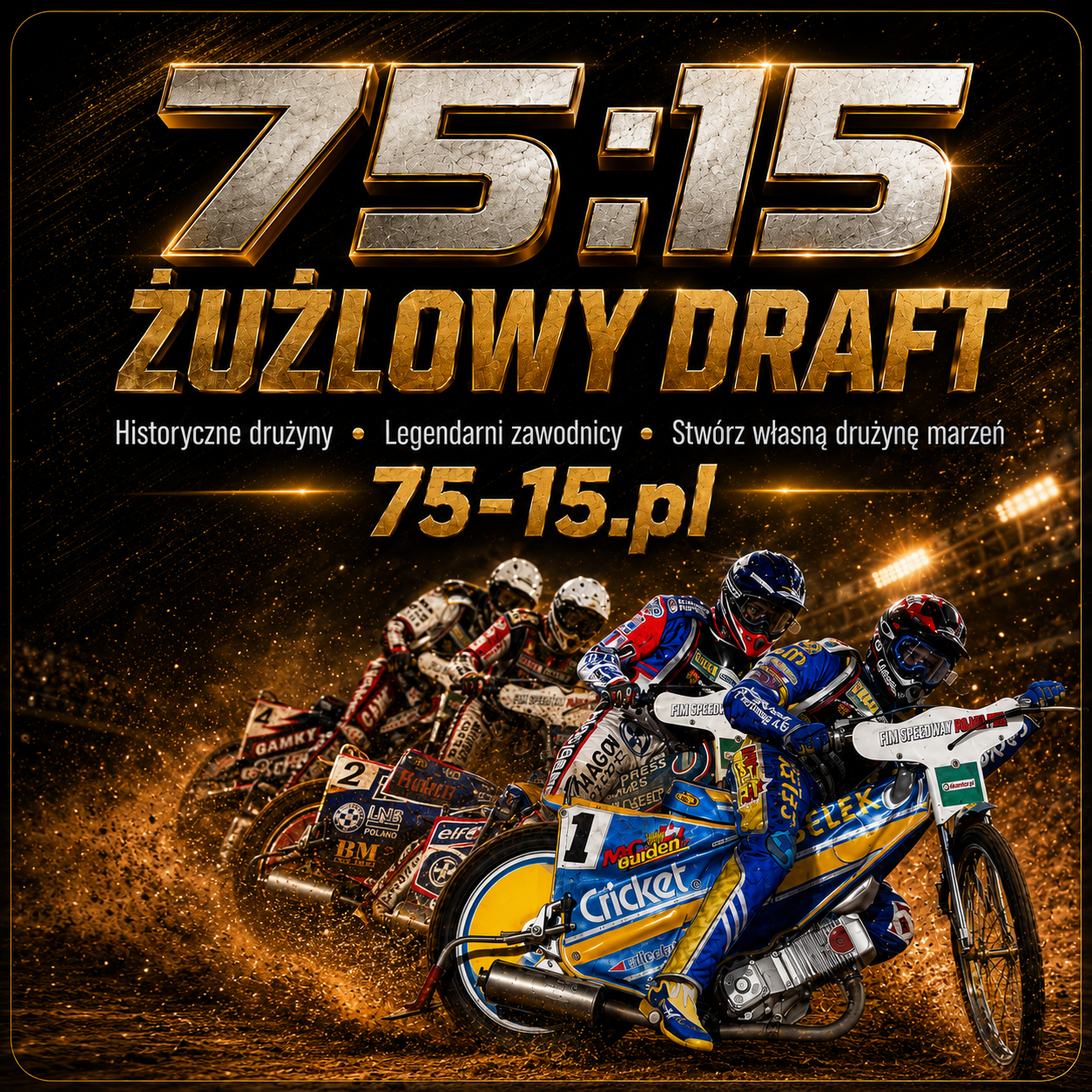
75:15 Speedway Draft League: A Historical Speedway Sandbox Built Around Decisions
75:15 Speedway Draft League has grown from a historical squad-building experiment into a much broader browser game. Public alpha v160 now combines management, simulation, career progression, real Grand Prix seasons, national-team tournaments, an arcade racing mode and online play — all inside one project built around the history and tactical character of speedway.
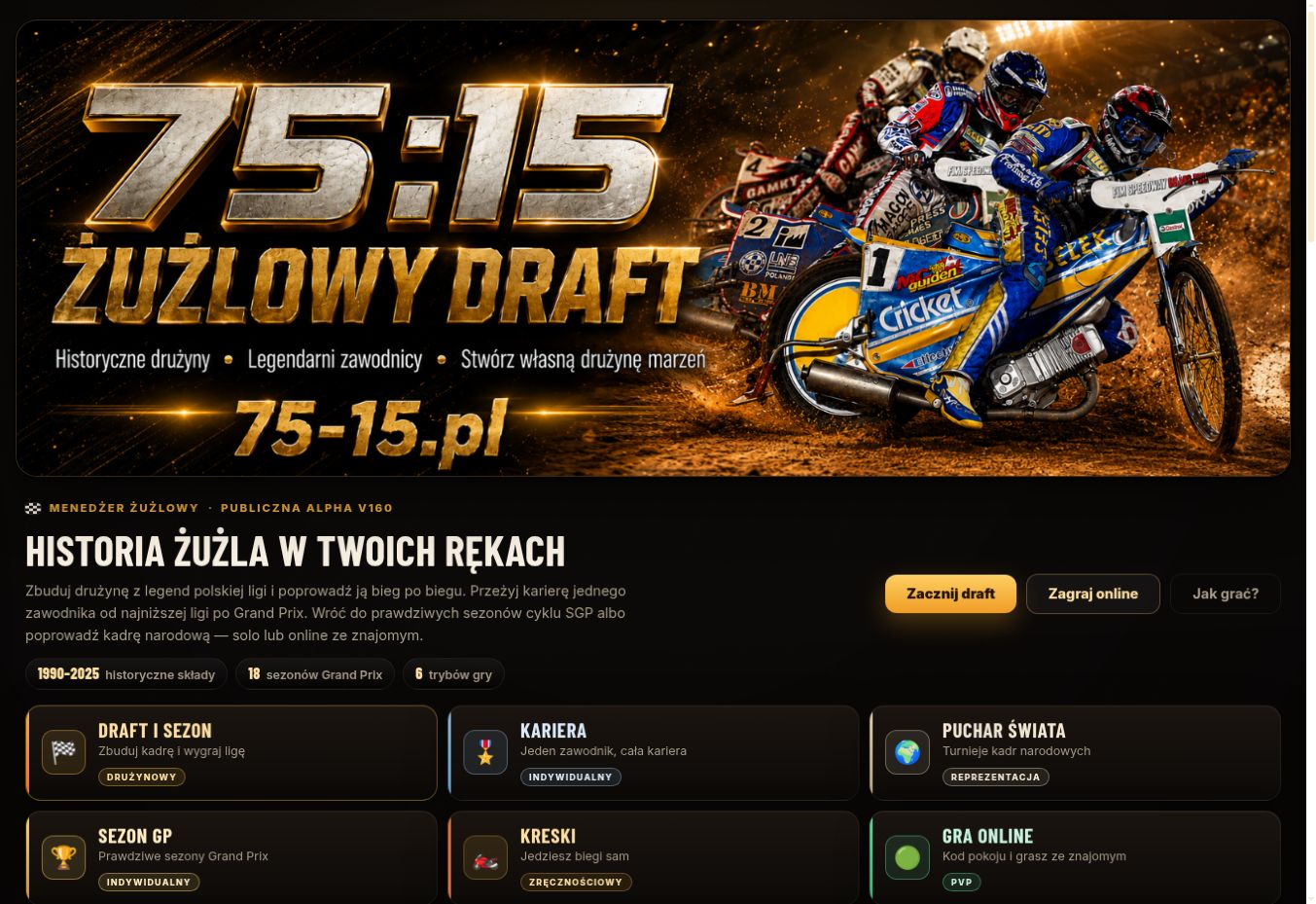
The redesigned main screen presents the six principal ways to play: Draft and Season, Career, Speedway World Cup, Grand Prix Season, Kreski and online multiplayer.
The central idea remains simple: give speedway supporters the decisions they usually debate from the grandstand. Who should lead a pair? Is a star rider worth the KSM cost? Should a junior be protected or thrown into a decisive heat? Which historical version of a rider belongs in an all-time team? The current build turns those questions into a connected set of game modes rather than a single match simulator.
The database now covers historical Polish league squads from 1990 to 2025, while the Grand Prix module recreates 18 selected seasons from different regulatory eras. The result is not intended to be a passive encyclopaedia. Historical data becomes the raw material for new teams, alternative careers and seasons that never happened — but might have.
The classic draft: build a team that can actually function
The classic Draft and Season mode is still the strategic foundation of 75:15. The player builds an eight-rider squad by drawing real club-season packages and choosing one rider at a time. Each choice must fit a defined role: leader, second-line senior, pair leader, Polish senior or U24 rider, finisher, two juniors and a rotation rider.
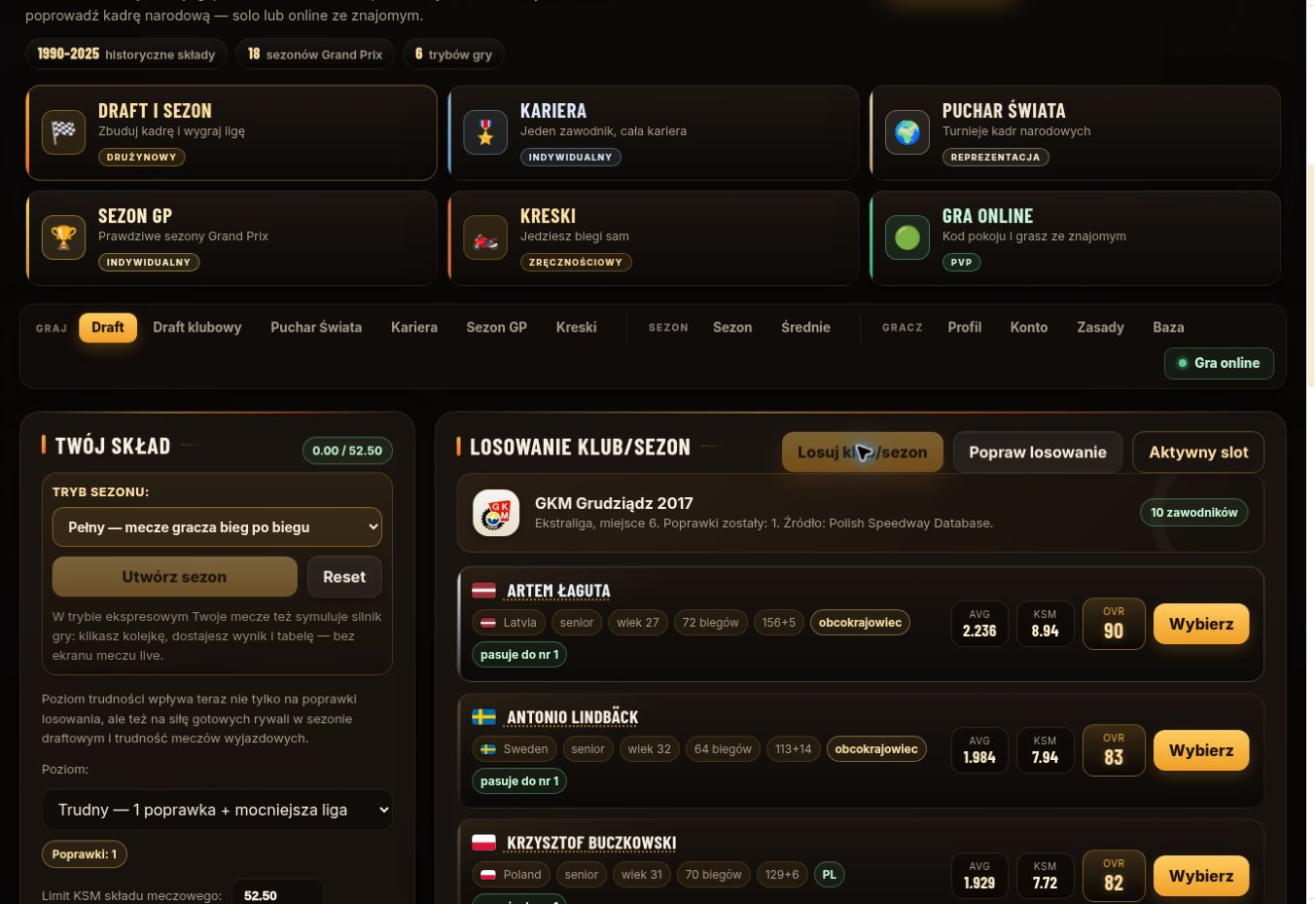
A GKM Grudziądz 2017 package. Rider cards show nationality, age, starts, points, average, KSM and OVR before the player commits to a selection.
This structure prevents the draft from becoming a simple collection of famous names. The default match-day limit is 52.50 KSM, the rotation slot has its own adjustable ceiling, and the player can set a foreign-rider limit. Difficulty also matters. Normal, Hard and Expert alter the number of redraws, the strength of automatically generated opponents and the challenge of away meetings.
Once the squad is complete, it can enter either a full season — with the player’s matches handled heat by heat — or an express season focused on fixtures, results and the league table. The current database contains 309 top-flight club-season entries, giving the draft enough range to produce both obvious superteams and wonderfully awkward combinations that require actual management.
There is also a Club Draft for supporters who prefer loyalty over complete freedom. Here, every selected rider must have represented the chosen city or franchise. The game recognises changes of club name across different eras, so a Wrocław pool can include riders recorded under Sparta, Atlas and Betard Sparta. It is a more restrictive mode, but also one of the most satisfying: instead of asking for the best possible team, it asks for the best possible version of your club.
Career mode: one rider, an entire sporting life
Career mode changes the scale completely. Instead of controlling a club, the player creates one rider, selects nationality, debut year, riding profile, background and natural talent, then starts at the age of sixteen in the lowest available league of that period.
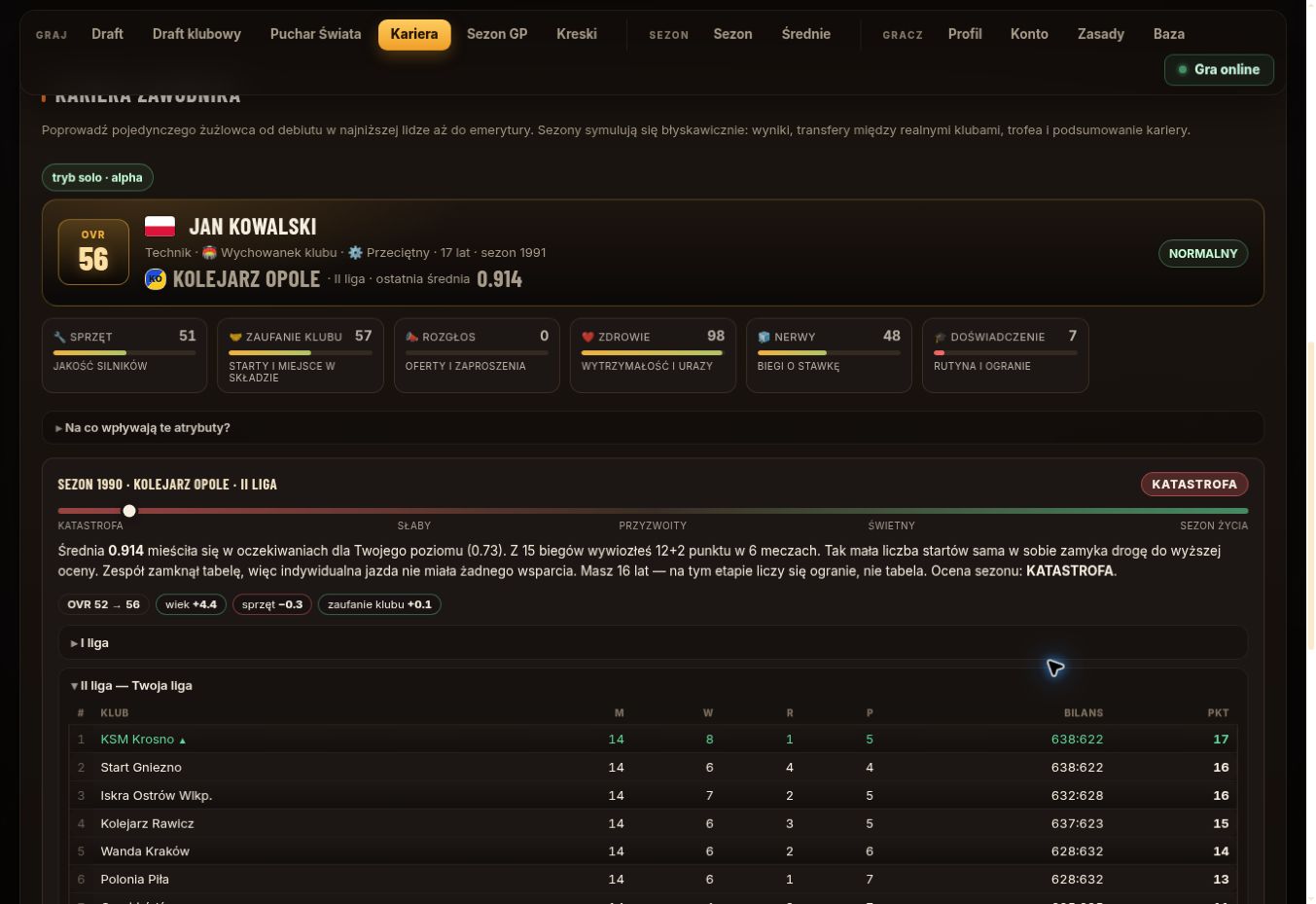
A completed 1990 season in Career mode. The screen combines sporting results, attribute development, league context and a written assessment of the year.
The first decision may already involve a compromise. A more prestigious team can offer better money but fewer starts; a smaller club may provide the track time needed for development. From there, the career advances through complete seasons, contract offers, transfers, finances and invitations. Performance is measured through more than one overall rating. Equipment, club trust, publicity, health, composure and experience all shape what happens next.
The system also introduces narrative decisions between seasons and important events. Some offer a safe improvement; others involve risk, reputation or short-term sporting consequences. Because the mode uses real clubs appropriate to the selected era, a career beginning in 1990 feels different from one starting in the modern league structure. The goal is not simply to maximise a number, but to produce a believable sporting biography: reserve appearances, failed transfers, breakthroughs, injuries, strong seasons and, eventually, a complete record of the rider’s career.
Speedway World Cup: draft a nation, then manage the tournament
The Speedway World Cup mode uses the same historical database in a different way. The player chooses a country, drafts a five-rider national team and takes it through two semi-finals, a race-off and the final.
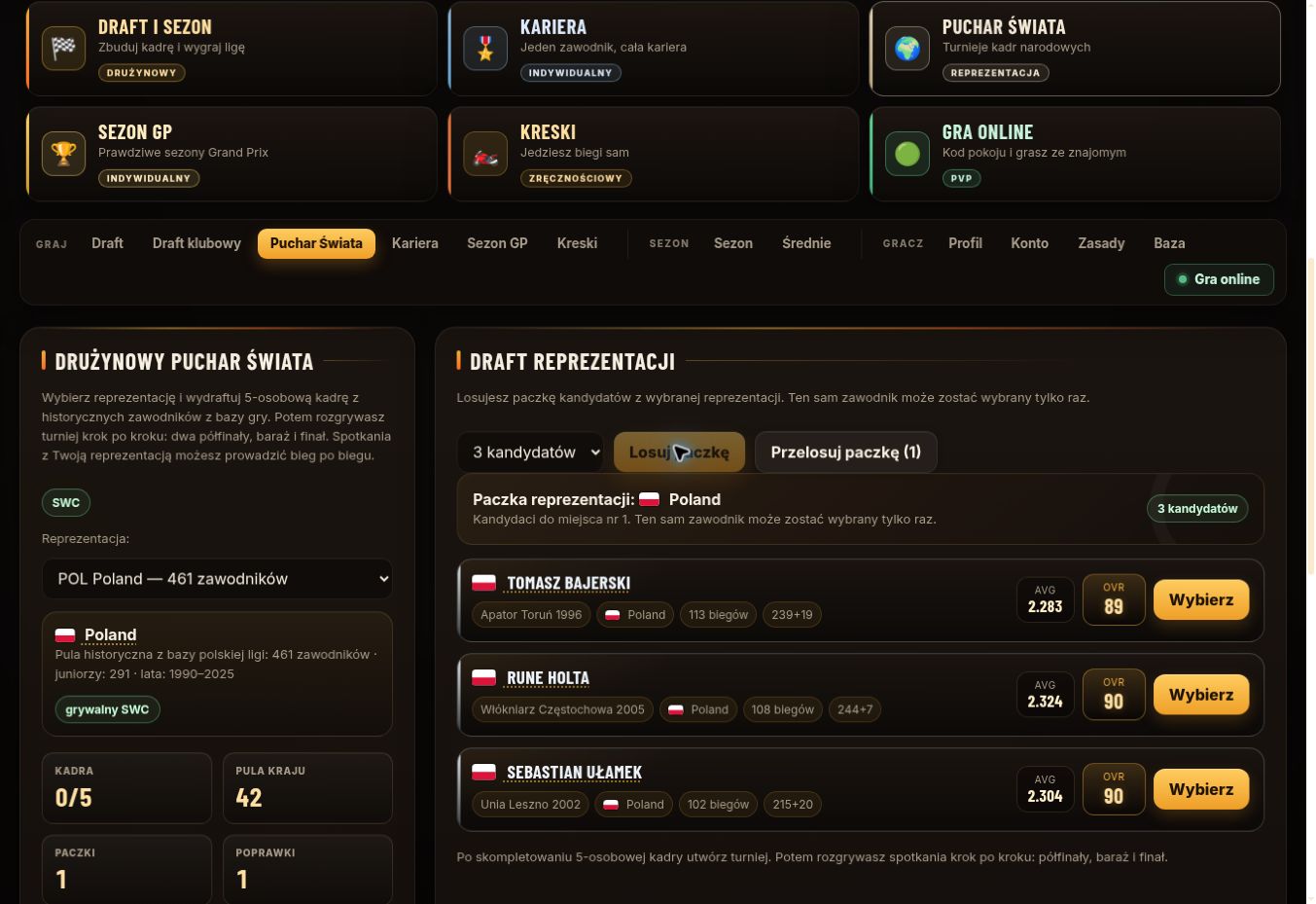
The Polish national-team pool draws riders from different clubs and years. Each card retains the historical season behind that version of the rider.
Meetings use four national teams, 25 heats and the traditional 3–2–1–0 scoring system. Every rider has five programmed starts. Tactical substitutes become available when a team falls six or more points behind the leader, while the Joker can double a score once the deficit reaches ten. Those rules make the mode recognisably different from ordinary league racing and recreate the specific pressure of the classic World Cup format.
The draft is important because nationality alone does not create a balanced side. A team still needs five riders capable of surviving the complete programme, and the strongest name on paper is not always the best use of a limited selection opportunity. Smaller national pools also create a different kind of challenge from Poland, Denmark, Sweden or Australia.
Grand Prix seasons: real calendars, real fields, era-specific rules
Grand Prix Season is the most explicitly historical mode in the project. Rather than applying one universal system to every year, 75:15 changes the tournament structure and scoring to match the selected era. The current selection begins with the inaugural 1995 series and reaches 2024, covering the early finals, the 24-rider elimination years, the 21-point format and the modern system based on finishing position.
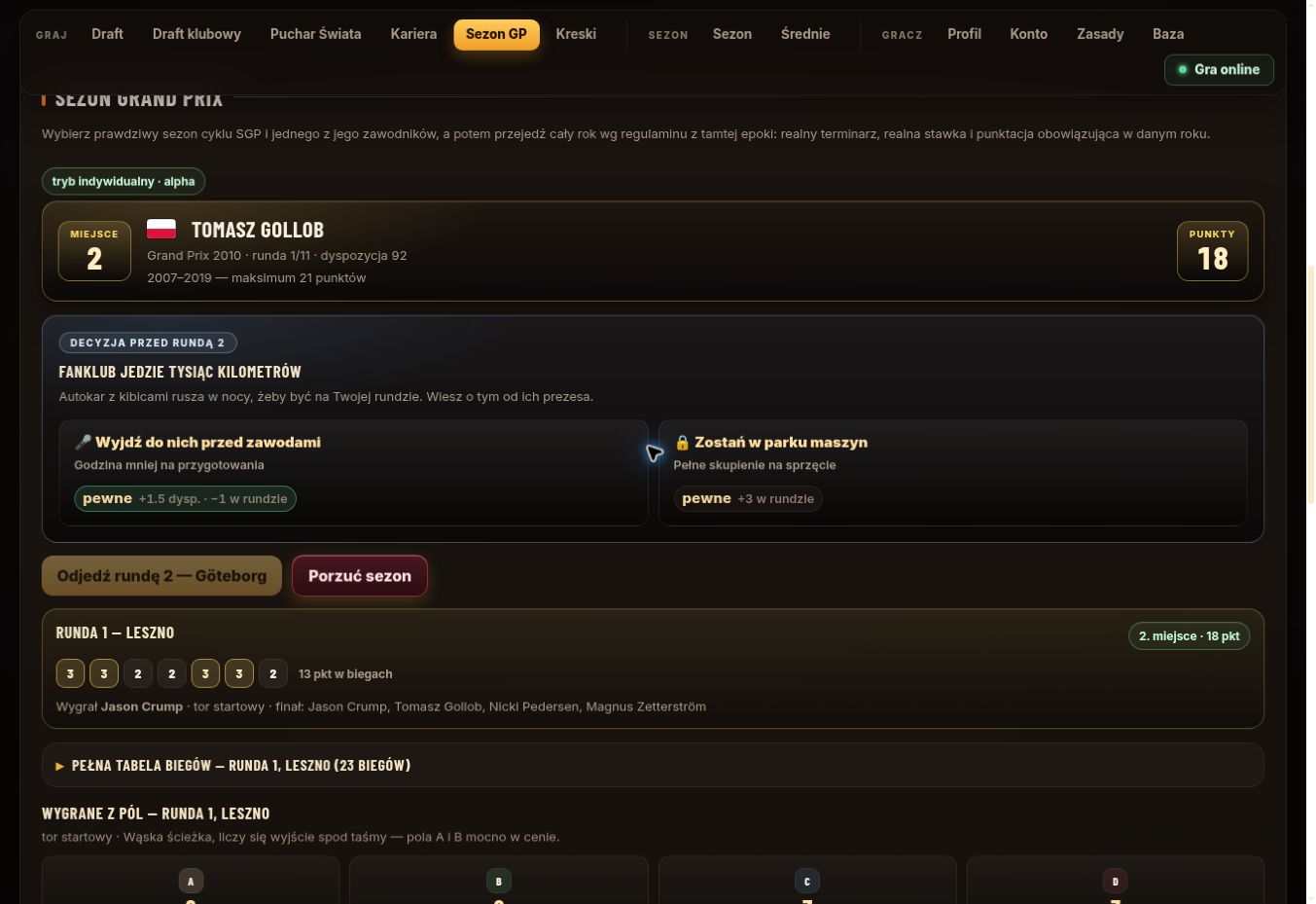
A recreated 2010 campaign with Tomasz Gollob. The Leszno result includes individual heat scores, the final classification, track-character information and a decision before the next round.
The player chooses a real participant from the season’s field and follows the authentic calendar. A campaign can be handled through quick simulation or played through the full programme heat by heat. After each round, the game records the result, updates the championship table and presents relevant information about the circuit, including the performance of individual starting gates.
The mode creates space for both reconstruction and counterfactual history. A player can attempt to repeat Tomasz Gollob’s 2010 title, rescue a difficult real-life campaign or take a lower-ranked rider into a championship fight. Crucially, the surrounding field and rules still belong to that specific season.
Kreski: the moment the manager has to ride
Kreski is the deliberate change of pace. It is a top-down arcade mode played inside a complete 15-heat league match. The player controls their own races with the keyboard: the right arrow handles acceleration from the start and straightens the motorcycle, while the left arrow adds turn. The rest of the meeting is simulated by the game engine.
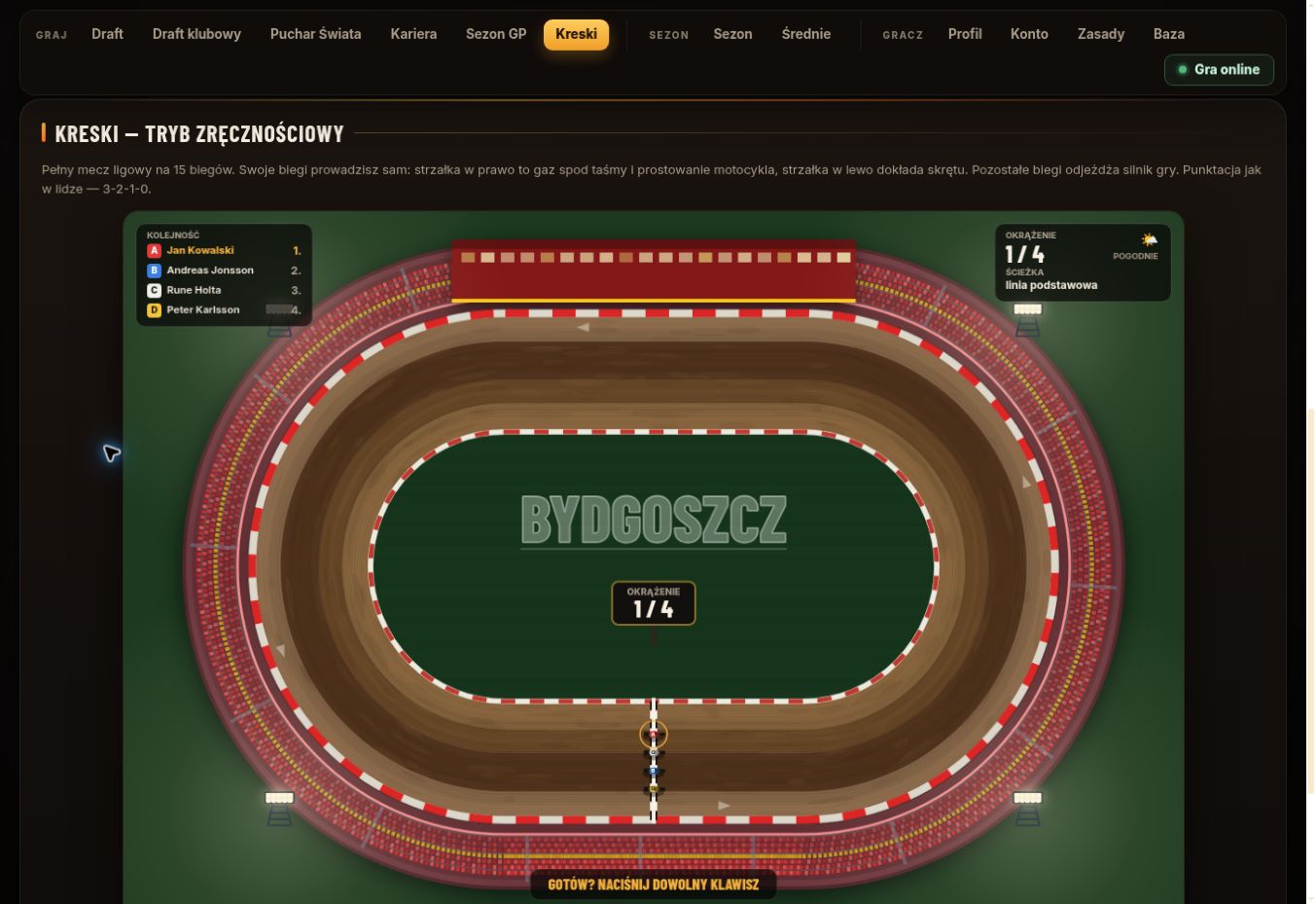
The top-down track view during a 2010 meeting in Bydgoszcz. Position, lap, weather and the active racing line remain visible while the heat is in progress.
This is not a detached minigame. The match still uses real historical team line-ups and rider averages, the standard 3–2–1–0 scoring system, tactical changes and nominated heats. Track length, surface and weather influence the feel of the race. Kreski can be opened as a quick historical match or played as a separate rider career with league tables, transfers, development and the option to simulate less important fixtures.
The mode gives 75:15 something most management games avoid: direct responsibility. It is easy to blame the algorithm after a poor result; it is more difficult when the decisive point was lost because the player ran too wide on the final bend.
Online play: from one historical match to a complete season
The online lobby extends the project beyond solo play. Two players can create or join a room using a short code, with the selected room type recognised automatically.
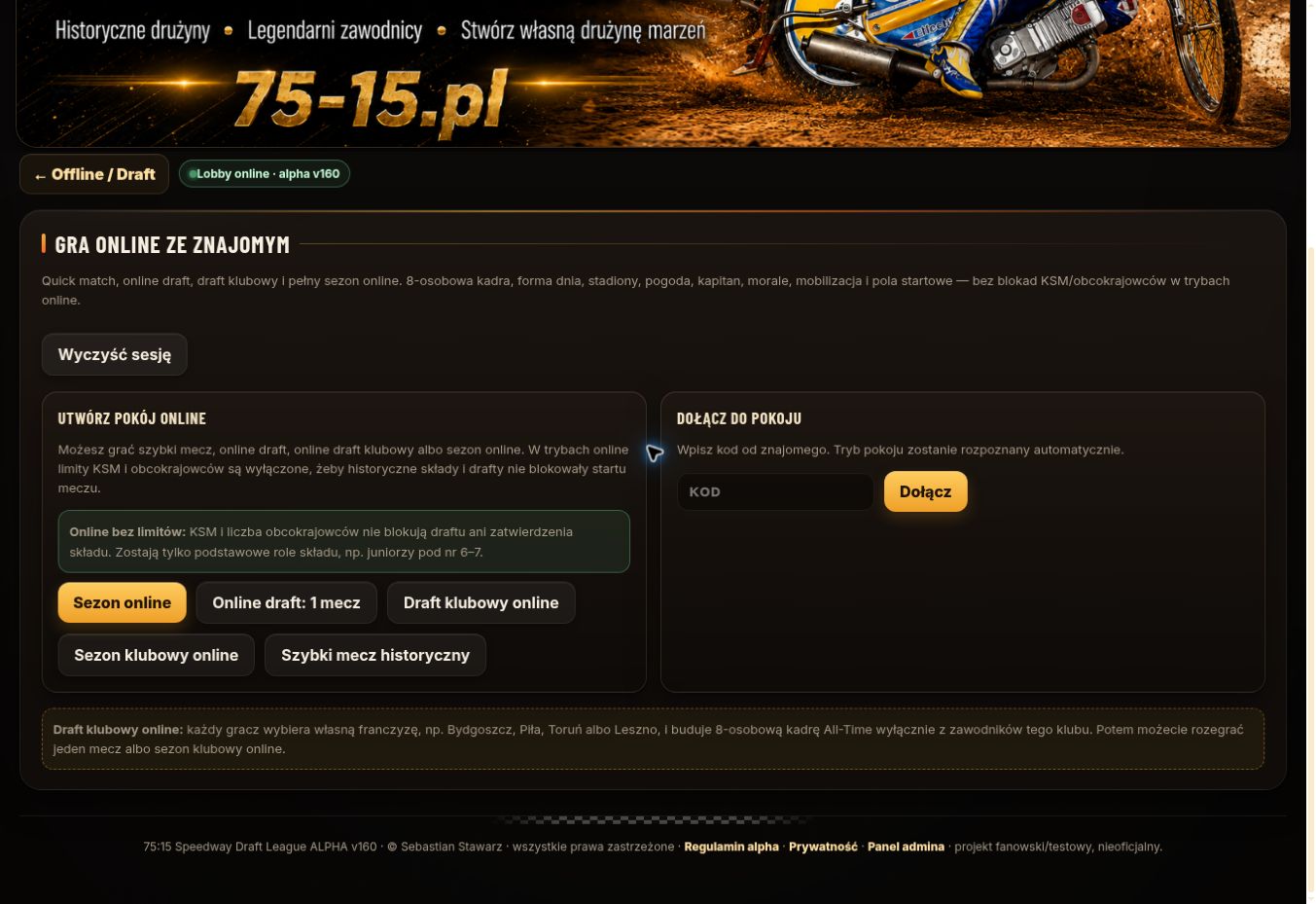
The current multiplayer lobby offers a full online season, a one-match online draft, club draft, club season and a quick historical match.
Online formats intentionally remove KSM and foreign-rider restrictions so that historical squads and drafted teams do not become impossible to approve. Core positional rules remain — including the junior positions — but the emphasis is on creating a playable contest between two people. The current lobby supports a quick historical match, a one-match online draft, Club Draft online, a complete club season and the broader online season format.
Underneath those modes sit the systems that give matches their personality: daily form, stadium and track conditions, weather, captaincy, morale, motivation and starting gates. Online play therefore offers more than comparing two OVR totals. Both managers still have reasons to adjust a line-up, react to a bad start and argue afterwards that one tactical decision changed the entire meeting.
Where the project stands now
75:15 Speedway Draft League remains a public alpha and an independent, unofficial fan project. Balance, historical data, interface details and multiplayer behaviour will continue to evolve. That status is important, but it no longer means the game is a narrow prototype. Alpha v160 already contains several distinct games connected by one database and one design philosophy: speedway history should be something the player can use, challenge and rewrite.
The next stage is refinement rather than reinvention — improving balance, expanding historical coverage, tightening the interface and making the transitions between drafting, managing and racing even more natural. The identity of the project is now clear. It is a historical speedway sandbox for people who enjoy the numbers, but stay for the decisions and the drama behind them.
https://play.75-15.pl/