
People sometimes ask me why women so often become the main characters in my stories. I understand the question. I write about history, war, power, faith, class, fear, love, bad decisions and all the other things humanity has been producing with impressive commitment for centuries. Traditionally, these subjects arrive wearing a male uniform. Kings. Generals. Pilots. Cardinals. Officers. Politicians. Men with maps, medals, cigars, swords, moustaches and the emotional accessibility of a locked railway station at midnight. And yet, when I sit down to write, I often find a woman at the centre of the room. Not always loudly. Not always dramatically. Sometimes she is just standing there, listening while everyone else talks too much. Sometimes she is tired. Sometimes angry. Sometimes trying very hard not to laugh at the wrong moment. That last one is usually when I start trusting her. I do not think I chose this as a strategy. I did not wake up one morning, drink a heroic amount of coffee and announce, “From now on, women shall lead my fiction.” That would sound far too organised for me. My creative process is usually less like a military operation and more like entering a room full of smoke, knocking over a chair, finding one interesting person in the corner and deciding to follow them. Very often, that person is a woman. Maybe because history has always been full of women, but it has not always been very polite about admitting it. Official history loves a man on a horse. It loves a treaty, a battle, a crown, a parliament, a general pointing at a map as if the map personally offended him. There is nothing wrong with those things. They matter. But they are not the whole story. Someone was also waiting at home. Someone was working in the factory. Someone was carrying the child, hiding the letter, counting the money, burying the dead, listening for the planes, keeping the secret, standing in the queue, watching the door, making the tea because apparently even the end of the world requires a hot drink. That is the part I keep returning to. I like history when it stops being marble and starts being skin. When it is no longer a chapter title, but a woman trying to get through one impossible day without falling apart in front of people who would not know what to do with her pain anyway. There is something powerful in that. Not clean power. Not poster power. Not the kind of heroic strength that comes with perfect lighting and a soundtrack. I mean the ordinary, stubborn kind. The kind that looks almost boring from the outside because it does not announce itself. A woman gets up. She goes to work. She answers the phone. She reads the message. She does not cry yet. She makes a joke so dry it should probably be registered as a fire hazard. And life continues, because she forces it to. That interests me much more than perfection. I have never wanted to write perfect heroines. Perfect characters make me suspicious. They feel embalmed. They stand on the page with good posture and no pulse. I prefer women who are a little inconvenient. Brave, but not always kind. Clever, but not always right. Loving, but sometimes terrible at showing it. Proud when they should listen. Silent when they should speak. Speaking when silence would have been safer. In other words, human. That is important to me. I do not want women in my stories to exist as symbols with nice hair. I do not want them to be moral decorations placed beside a man so he can finally discover his feelings after three hundred pages of causing problems. Literature has already made women do far too much unpaid emotional labour. My female characters need their own life. Their own hunger. Their own mistakes. Their own anger. Their own bad timing. Their own private darkness. Their own ability to look at a disaster and say something completely inappropriate, because sometimes that is the only honest response available. I think this is where humour becomes essential. I cannot write darkness without humour. I do not trust darkness when it behaves too seriously. Real life rarely does. Even in the worst moments, people say absurd things. Someone complains about the tea. Someone notices the wallpaper. Someone makes a joke in a hospital corridor and then feels guilty for laughing. Someone looks at catastrophe and says, “Well, that could have gone better,” which may be the most British sentence ever invented, apart from “I’m fine” said by a person who is absolutely not fine. That kind of humour is not a lack of emotion. It is emotion trying not to drown. I often give that humour to women because it suits the way many of my heroines survive. They do not always have open power. They cannot always shout. They cannot always strike first. So they observe. They read the room. They notice who is lying, who is frightened, who is vain, who is cruel, who thinks they are too harmless to matter. Being underestimated is dangerous. But it is also useful. People reveal a shocking amount when they believe you are part of the furniture. And I have already said I do not write furniture. There is a particular tension in writing women in historical settings. The world around them often has very clear ideas about who they are allowed to be. Be quiet. Be good. Be grateful. Be modest. Be useful. Be pretty if possible, but not too aware of it. Be clever, but not in a way that makes anyone uncomfortable. Be strong, but do not ask to be recognised for it. Suffer, but please do it neatly. That kind of pressure creates story before the plot has even begun. A woman who wants to live honestly inside a world built to reduce her is already in conflict. She does not need a dragon. Society has usually provided enough obstacles by breakfast. What fascinates me is not simply rebellion in the loud sense. I like quiet rebellion too. The small moment when a woman stops accepting the version of herself that others have prepared for her. A question asked at the wrong table. A glance held for one second too long. A letter hidden. A truth spoken. A door opened. A decision made in silence. These things may look small, but they are not small when the world has spent years teaching you that obedience is virtue. Some of my favourite moments in fiction are not explosions or dramatic speeches. They are the moments when a character quietly thinks: enough. No thunder. No orchestra. Just a human being reaching the end of what they are willing to tolerate. That, for me, is where a story begins to breathe. I also think women often bring history closer to the body. Through them, war is not only strategy. It is waiting. It is not knowing. It is reading a list of names and pretending your hands are steady. Poverty is not only economics. It is shame, hunger, calculation, the small humiliation of needing help. Love is not only romance. It is risk. It is fear. It is the unbearable thought that someone you love may become a sentence in a telegram. The large events matter, of course. Battles matter. Politics matters. Systems matter. But I am most interested in what those things do to one person. How they change the way someone speaks. How they teach someone to lie. How they make someone older in a week. How they turn a joke into armour. Female characters often give me the most honest way into that space. Perhaps because women have so often been asked to carry pain privately. To continue. To manage. To comfort others while needing comfort themselves. To hold a family together and then be told that the important history was happening elsewhere. I do not believe that. I think the important history is often exactly there: in the kitchen after the telegram, in the shelter during the raid, in the factory after the accident, in the room where someone folds a letter and decides not to cry until later. That “later” can contain an entire novel. Of course, writing women as a man requires care. I know that. I do not pretend to fully understand women. Any man who says he fully understands women should probably be offered tea, a biscuit and a long reflective silence until the danger passes. I do not even fully understand myself, and I have had direct access for years. But writing has never been about owning another person’s truth. It is about listening. Watching. Imagining with respect. Accepting that people are not categories. They are contradictions with shoes on. That is what I try to write. Not “female characters” as a concept. Women as people. People with wounds, wit, pride, longing, fear, tenderness, irritation, courage and the occasional desire to throw something heavy at someone who richly deserves it. So why do women so often lead my stories? Because when I look at history, I keep finding them where the real pressure is. Because their courage is often quieter and more complicated than the kind that gets a statue. Because their humour can cut through darkness without pretending the darkness is not there. Because their emotional lives are not side plots. They are worlds. Because I like characters who have been underestimated by everyone except the reader. And because, very often, the woman in the corner of the room is the only one who has understood what is really happening. She may not have the title. She may not have the sword. She may not be invited to the table where men are busy making a mess of the century. But she sees. She remembers. She survives. And sooner or later, she speaks. That is usually when I know the story is hers.
Back to Articles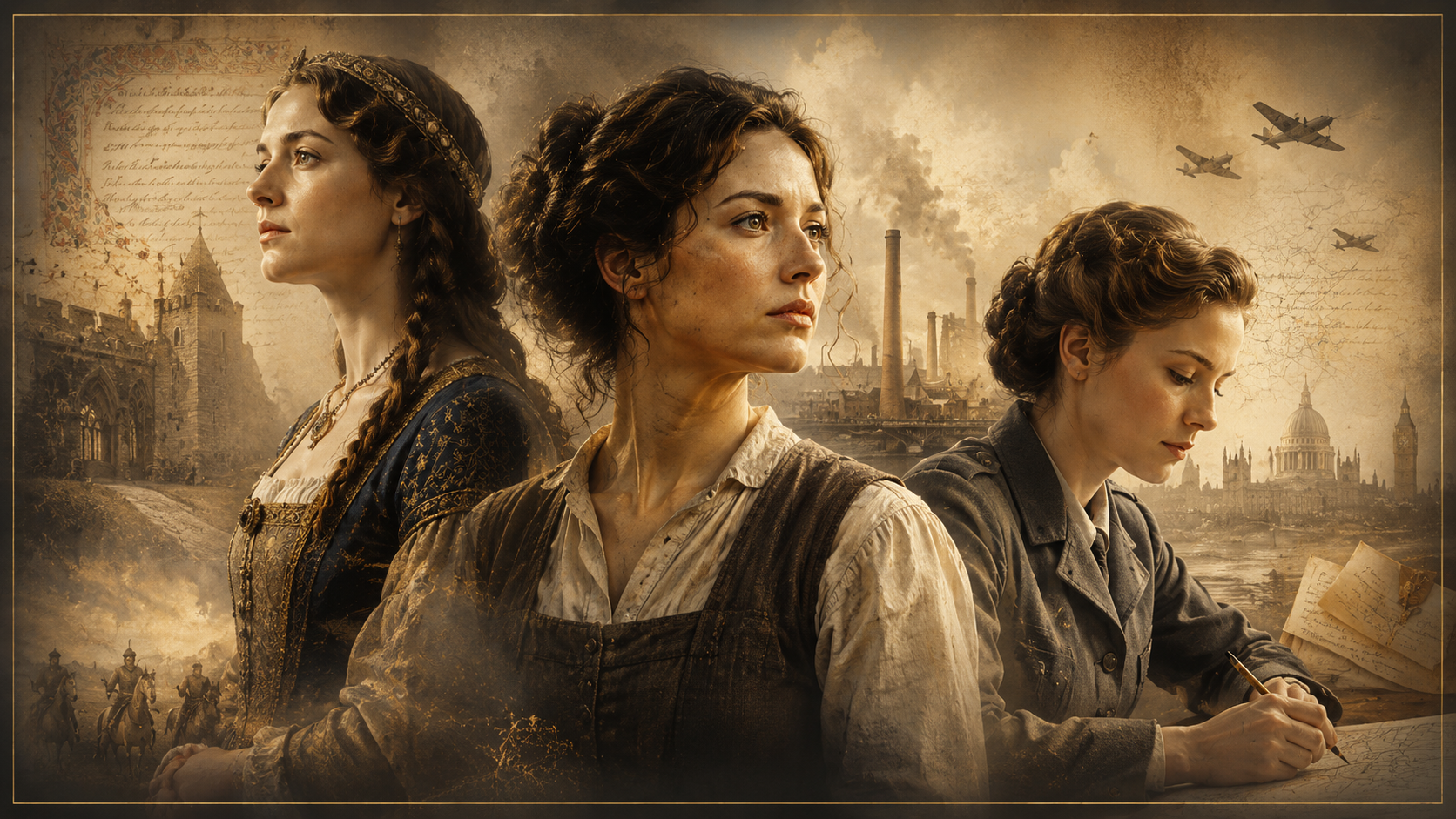
Writing JournalJune 30, 2026·8 min read
Why Women So Often Lead My Stories
I often write women as my main characters because history has spent far too much time placing them in the background, even when they were the ones holding the world together. This article is about why I am drawn to female perspectives, imperfect heroines, quiet courage, sharp humour, emotional truth and the kind of strength that does not need a statue, a sword or a dramatic speech to matter.